
Messy Church is a way of being church that is Christ-centred, for all ages, based on creativity, hospitality and celebration.
Over the past 10 years, there have been a series of surveys and research projects that ask questions around who comes to Messy Church, who leads a Messy Church, is there evidence of discipleship?
Our current research project, Messy Momentum, asks questions of our ‘for all ages’ value. At its heart, Messy Church is for everyone. All-age is shorthand for being church for everybody, welcoming all ages, abilities, learning preferences, spiritual styles, all backgrounds, levels of interest in God.
We seek to be intergenerational, where two or more generations interact together, sharing in the same activity and conversation, learning to share life together.
It is based on the concept that the church is the body of Christ and that we need each other, in all our differences, to grow as followers of Jesus.
We recognise that children can learn from adults. They need adult Christians who can testify that they’ve stuck with faith through the hard times, as well as the easier times.
Adults can learn from children and young people. Adults need to relearn the joy and exuberance that children express as they discover God’s amazing world. We all learn how to love each other and to love God by spending time together.
Whilst the shape of Messy Church is created around the needs of those with children, these needs may also be present in the lives of individuals who are at a different stage of life. ‘God sets the lonely in families.’ Poorly done, it can focus on children under 11 years, but a good expression will include adults and young people.
Anecdotally, we knew this is an area that Messy Church leaders find hard. Many Messy Churches notice a drop in attendance once a child transitions from primary to secondary school, around 11 years.
Seeking to understand more, in February 2024, alongside 9Dot Research, we asked Messy Church leaders to fill out a survey, which received 331 UK responses. We compared it to a similar survey, Church Army’s Research Unit 2016 report The Day of Small Things (DOST), which gathered data from 2012 to 2016 on 360 Messy Churches. There are many similarities, giving confidence that Messy Church continues to be successful in the following areas:
- Attendees are mainly non-churched: 90% of Messy Churches who responded have good numbers of non-churched.
- For 55% of attendees, Messy Church is their only church.
- Messy Church operates in all UK geographical areas, making a significant impact in small towns and rural areas, where it can easily double the size of a small church.
- Messy Church is hosted in relatively small churches (only 13% in churches of 100+).
- 42% of Messy Churches report they are growing, 40% staying the same size, only 5% declining.
- The average size of a Messy Church is 42 (adults and children). DOST (2016) found the Messy Church average figure was bigger, at 52. The decrease in average size is likely to reflect the pre- and post-Covid dating of the two reports.
- Messy Church is very successful in attracting young families, with 56% of attendees under 12 years old (16.9% of UK population is under 12 years old).
- 4% of attendees are aged 12–16-year-olds (the demographic profile in UK for this age range is 3%).
- 50% of Messy Churches are without young people aged 12–16 years.
We asked the question, what happens next for young people that leave?
Good news is that at least 20% continue their faith journey either at the same church or elsewhere. However, 19% lose their connection with church and 41% we have no idea about.
Our researcher identified that the Messy Church most likely to keep hold of their young people are the big Messy Churches, the big evangelical churches (better resourced) in the larger towns, where there is cross-over with the regular Sunday congregation.
Young people are more likely to stop going to church from smaller churches, in rural areas, and where there are fewer Sunday churchgoers in the Messy Church. Remember the survey finding that it’s the rural areas and small towns where Messy Church is making a big difference to the local church? The flipside of this is that these churches are not equipped for when the child becomes a young person.
We asked leaders what they thought are the most important factors in encouraging young people to continue with church as they grow older, either within or outside Messy Church. Choosing four options from a list 16 factors, the top six actions can be seen in the chart below:
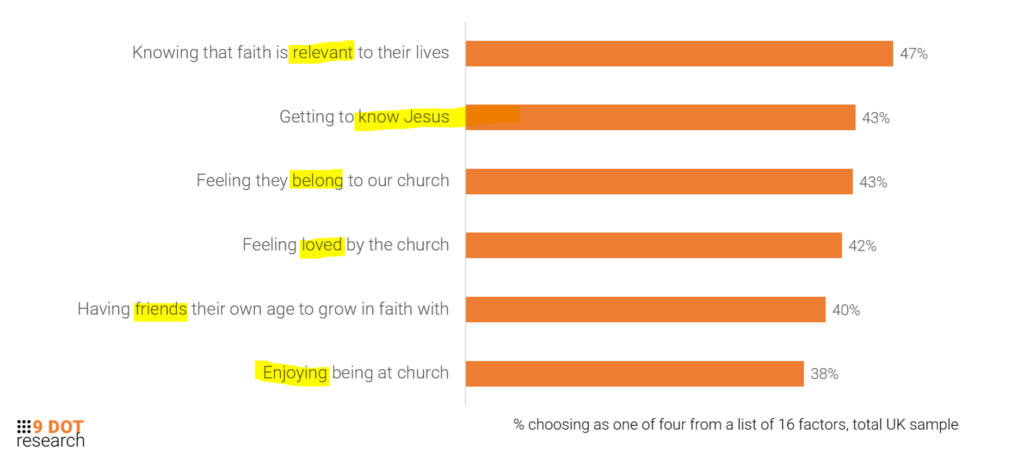
Interestingly, those who continue to engage young people, were twice as likely to choose ‘relevance’ over enjoyment.
Recommendations from our researcher:
- What we’re doing is great BUT…
- Be more intentional with faith nurture and discipleship of children and young people.
- Make sure they have friends to grow in faith:
- within a Messy Church
- between Messy Church & the wider church family
- look for peers elsewhere if none
- friends might be older
- Make faith relevant to young people as they will have new challenges at this stage of life
- Keep in touch with families that leave, where possible. If moving area, research and suggest a new church to try out
Our challenge at Messy Church, if we are going to live up to our ‘for all ages’ key value, is that we need to try something different if we want to see the continued engagement of young people in Messy Church or within the wider church, particularly in rural areas and small churches.
This research enabled us to get funding from the Church of England, for a new research project, Messy Momentum, to try out new ways of engaging young people in faith as they grow up through Messy Church.
In January and February 2025, we started with a listening exercise. Accompanied by our research partners, Brendan Research, we hosted a series of in-person and online focus groups with older children and young people, their parents and MC leaders. We asked them to draw their hopes and dreams for 11+yrs involvement in Messy Church and then describe them.
Comments from the young people:
- Volunteering is good training in understanding people, but it can get overwhelming at times, especially in chaotic moments. Not every young person wants to be a leader.
- Young people are reluctant to invite their friends 1) if their friends are not already Christians/interested in Christianity and 2) because they cannot give their friends their undivided attention when helping.
- A parallel youth group was valued for being fun, sociable and a place where they can relax and not have to act as role models to younger children.
- Almost all valued space to talk and the chance to debate issues and discuss Bible teaching from different people’s perspectives.
- They were conscious of young children (or SEN children) needing a physically safe environment and teenagers can be boisterous. Zoning areas according to age was a common suggestion.
- Some felt that while Messy Church is confident with primary school age/stage, they can tell that some Messy Church leaders feel ill-equipped to deal with youth.
Meanwhile, our Messy Church Leaders admitted that most teams needed additional skills/resources to facilitate a gathering that really does cater for all ages.
We took our research findings to a two-day innovation workshop, inviting a group of youth and intergenerational experts, plus representatives from three Dioceses (representing northern, southern and rural geographies) to dream up new approaches that Messy Churches could try that would engage young people. The group came up with 18 ideas, which we refined to six:

Intentionally Intergen
With either a brand-new Messy Church or a re-launched one, this pilot will integrate all ages into the prayer, planning, preparation, presentation, participation and appraising of their Messy Church.
Friday night Messy
This approach happens in the evening (it doesn’t have to be Friday!), in a community space, starting with a meal together, exploring a theme through table-talk discussion and then through various activities in the four spiritual styles (word, emotion, action and symbol) before coming together again with reflections and tidy-up time. Everyone contributes to food, ideas and celebration.
The setting is key, requiring a relaxed, informal approach with space and time to build relationships. We hope to create an intergenerational approach, at a time that works for families with older children/youth, where everyone is involved in meals and theme setting, that allows for people to naturally gravitate towards peers as friendships build. We envisage this lower maintenance than a regular Messy Church session, as the activities (games, discussions) require less preparation and during the session, everyone is invited to help out.


Pick ‘n’ Mix
By providing a space within your existing Messy Church that focuses on young people, you can engage with them and make it work alongside what you already do. In this pilot there are a range of approaches that you can pick-up or adapt to work within your context such as: a table for teens; a youth lounge; or simply encouraging them to sit together for the meal and a discussion.
The important thing is providing a specific opportunity to connect with and disciple young people within your current setting. This is about adding something in or substituting an activity to your regular gathering, which is self-selecting for young people.
The emphasis is on creating an authentic, fun space for young people to be and have something ‘for them’. Through creating a feedback loop, you can adapt or provide according to suggestions from the young people. In time, they may take ownership and lead this area.
Co-journeying
This is a ‘buddy-style’ pilot, as we know that true discipleship is where everyone can learn from and grow more like Jesus by doing life and church together. This pilot connects adults in your local Messy Church with older children aged 9+ years to become ‘co-jo’s’, inviting them to build a friendship and ‘co-journey’ their faith together.
One person in your Messy Church (the co-jo co-ordinator) will be trained to spot and invite the co-jo’s (young and less young) and connect them into discipleship pairs, after some initial training and preparation.
We decided on using mutual language of ‘co-jo’s’, rather than the term ‘mentoring’ as we know faith can be encouraged both ways, creating ‘buddies’ within the Messy Church community that cultivates relational and reasons for young people to come back.


Messy Gather
This approach is about connecting Messy Churches locally and facilitating ‘gatherings’ between young people. This might work well in rural settings, where there are just a handful of young people in each Messy Church, to show there is a community beyond their Messy Church.
By listening to what they want and what works for them, we want to foster a network of young people and Messy Churches that truly embodies the Messy Church values and shows what church community is for young people.
I’d like to try…?
This is for Messy Churches that already have the inkling of an idea, or maybe one of their young people has an idea to try. We want to hear about it and help make that happen. We will facilitate a listening and learning community for these new initiatives, so together we can improve and inspire a Messy Church to innovate what works best for them.

Pilot Criteria
From June to September 2025, we aimed to recruit 25-30 Messy Churches to take part, with the following criteria:
- A cohort of 9+ year olds (minimum of 3)
- Monthly Messy Church gatherings
- Team capacity
- Commitment to the journey:
- Autumn term training and preparation
- January 2026 – December 2027 pilot running
We arranged screening calls with potential Messy Churches, to find out more about their current Messy Church set-up, talk through which approach might be most suitable for them to try and to check that the wider church leadership were supportive, through a signed agreement.
From September to November 2025, we are providing training for each approach, equipping them with Messy Church books and a small fund to buy additional resources.
Throughout the two-year pilot, there will be termly online learning community for each cohort, allowing the Messy Churches to learn from each other.
We are also working with Brendan Research, who have designed data capture tools: baseline and annual surveys; young people and parents short survey after each session using QR codes; and a reflective journal for Messy Church leaders to complete after each session to bring to the online learning community.
To address the issue that some Messy Church leaders feel ill-equipped to deal with youth, we have teamed up with Youthscape Essentials training, enabling two members of each Messy Church team on the pilot on a 10-week youth ministry course for volunteers.
What are we learning along the journey?
Whilst the pilot approaches are not due to start until January 2026, the learning has already begun.
We’ve allowed Messy Churches on the pilot to self-select which approach is most suitable for their context. The most popular is Pick’n’Mix, doing something for young people within an existing Messy Church gathering. One theory for this is that this approach requires the least amount of change and allows the time poor Messy Church team to do the one thing they can do.
The least popular approach is ‘Co-jo’s. Currently there are no Messy Churches on this pilot. One reason for the lack of uptake of this approach is perhaps that it requires more stringent safeguarding requirements and significant organisation by a local Messy Church leader. Secondly, with historic safeguarding abuse within the Church of England often in our media, Messy Churches may feel cautious about this approach.
To date there have been 29 Messy Churches signed-up to the pilot, however, eight have decided not to go further, mainly due to capacity issues, as a key leader (often clergy) circumstances have significantly changed and there is uncertainty around whether their Messy Church will be able to continue during the two-year pilot.
We look forward to discovering what happens next as the pilot approaches launch in January 2026 – watch this space!
It’s not too late to get involved with the project but don’t delay – contact our Youth Project Lead Sophie Harber today.
Aike Kennett-Brown
BRF Ministries Messy Church Ministry Lead UK
You may also like
2025 – a year in the life of Messy Church ministry
7th Jan 2026Aike shares her reflections on where God has been at work amongst BRF Ministries Messy Church team in 2025!

Aike’s Advent-tures in Finland
3rd Dec 2025Aike recently visited Finland where she encountered a winter wonderland and experienced star gazing, from dark skies to the amazing colours of the Northern Lights and God's awesomeness in creation, where love, light and hope can be found!

Messy Mary’s Mission to the Philippines
14th Nov 2025Mary Judkins is a member of our volunteer support team and leads a Messy Church Goes Wild in Cornwall. Read all about her recent mission trip to the Philippines.

When disaster strikes
24th Oct 2025Aike draws comparisons between a recent visit to Pompeii and warning signs in our Messy Churches!
