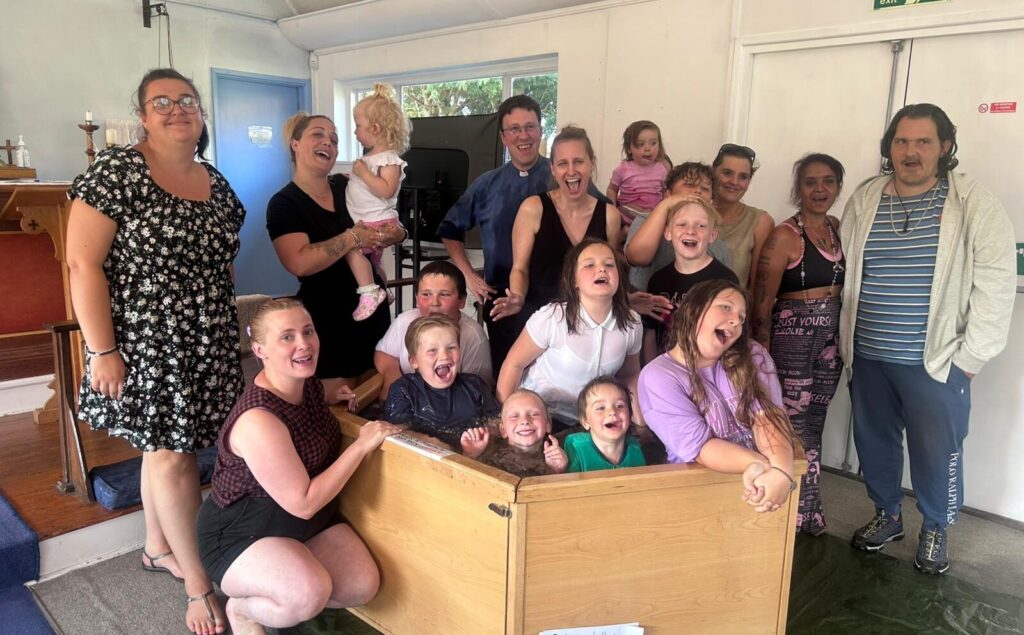
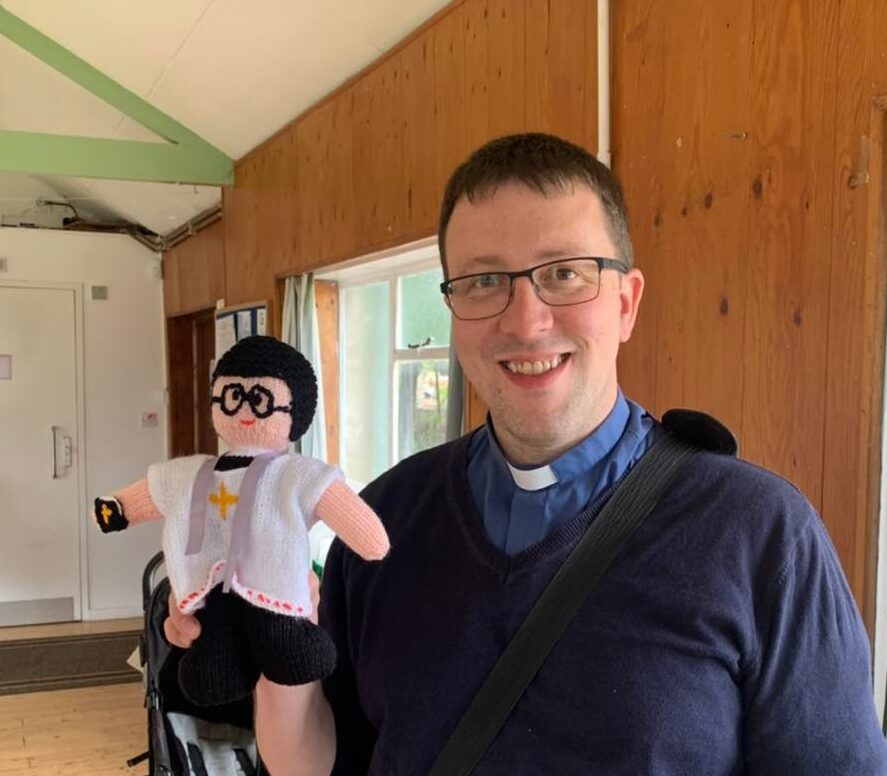
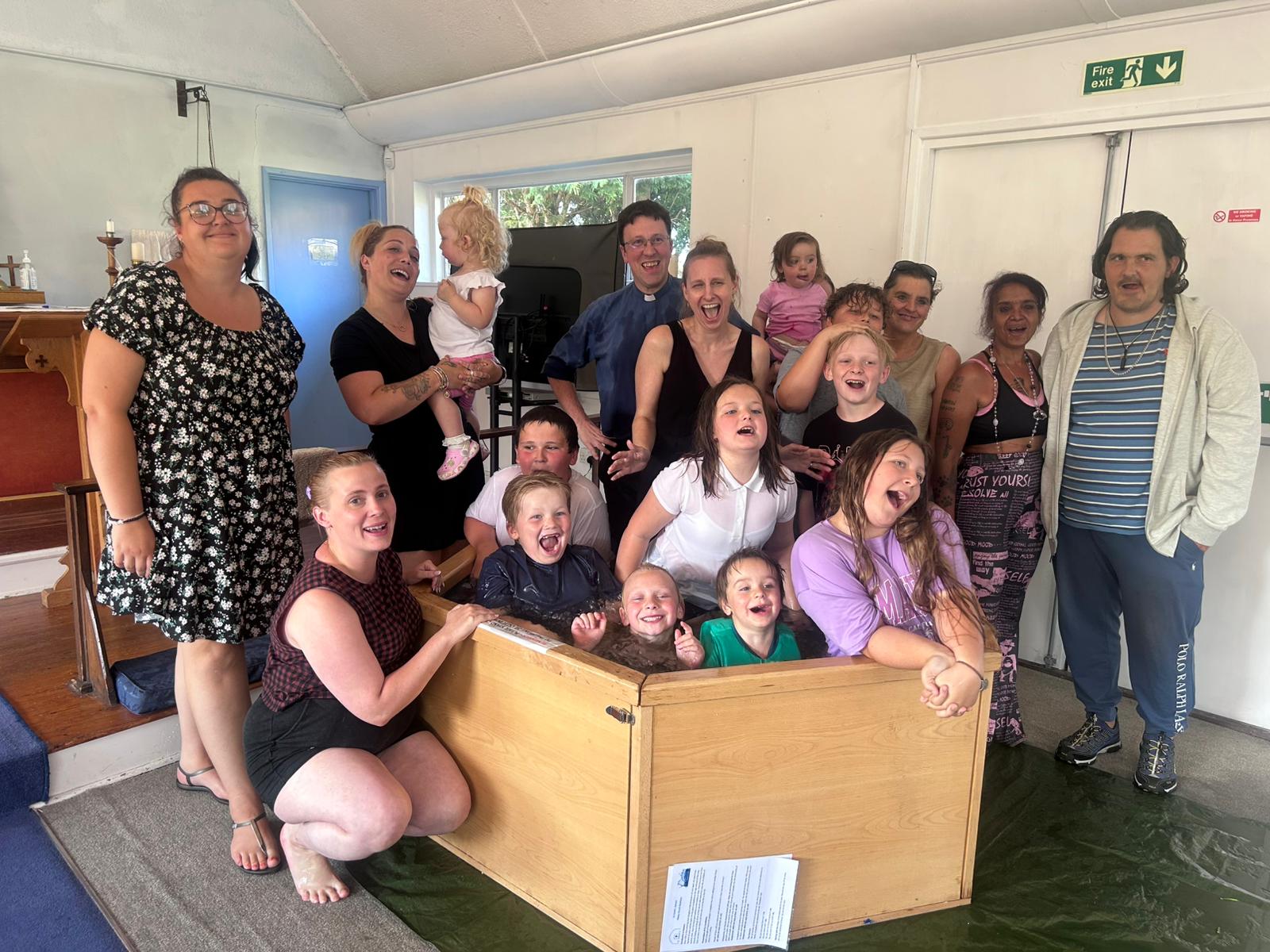
It wasn’t the highlight of the year, but of nine years when 5 adults and 9 children were baptised at a very special Messy service at St Mark’s, Downham, in south east London last summer. Team vicar Nick Walsh arrived nine years ago, in January 2026, and soon ‘fell in love with the community. It feels right. It feels like I fit here.’
St Mark’s was originally a ‘tin tabernacle’: one of the temporary corrugated iron churches put up on the ‘pre-fab’ estates built to house people bombed out in the war. Replaced by a permanent building in the 1960s, it now lies between the old pre-fab area and the ‘garden city’ estate put up between the wars.
‘There’s a lot of green space, despite being a housing estate,’ says Nick. ‘There’s a solid sense of community and a lot of opportunity. I’ve always had a heart for those who’ve been forgotten or on the margins, whether that’s church or society and Downham very much has that kind of history. There was actually a wall built to separate the estate from the rich area, so that the wealthy people from Bromley didn’t have to deal with the poor from Downham.’
Nick’s route to Downham – his first incumbency – included ordination training at St Melitus College, a placement as an ordinand in Shepherd’s Bush in West London and a curacy in Luton.
‘I have come to realise,’ he says, ‘doing some reflection during the pandemic, that I actually am a working class lad. I’d never really thought of it like that, but through my studies and being drawn to estate ministry, I see that I grew up in a working class family with working class values and I’ve always felt more at home in working class communities and with working class people. That’s a thread running through all of my ministry.’
It was only after he got the job at St Mark’s that Nick discovered that his godfather had grown up in Downham. ‘He almost did the reverse journey. I did Guernsey, to Luton to Downham, and he did Downham to Luton to Guernsey.’
The population of the parish is 31,293 and on the Church Urban Fund rank it is number 1057 out of 12,239, in terms of deprivation, when number one is the most deprived, so it’s within the top most deprived 10% of parishes in the country. Interestingly, apart from the health service and the education sector, the church is one of the biggest employers on the estate, because they employ a lot of people, albeit on a part-time basis, for their community roles.
The community is a mix of families ‘who have been here for generations’, who tend to be in social housing and many people who have moved in temporarily.
‘There’s lots of temporary accommodation – houses of multiple occupation – for, mainly, men who are very in and out all the time. Like a lot of places, it is very expensive so people are priced out and when houses do go up for sale, they’re snatched up by private landlords and split into lots of dingy little flats.’
Part of the history of Downham is that it used to be a major National Front hotbed. ‘The then council’s solution was to move loads of people from other nations and countries into the estate to try to dilute the National Front influence.’ In some ways that exacerbated the tensions. Nick sees ‘a lot of positives around the integration – lots of good news stories there – but there’s also a kind of volatility in the community at the moment.’
The turnaround began when Nick’s wife, Lucie, began encouraging the mums at the school gate to come.
‘And they started coming! All these working class mums from the community – the mums that people used to sneer at when they’d be outside the school gate, smoking and chatting and laughing loudly; the people that the school told us we’d never connect with!’
But the message from the mums was clear. This needs to change! ‘They took over,’ says Nick. ‘They started volunteering. They started preparing the food. They started looking at the activities. We did lose the original church volunteers, but they didn’t really want to do Messy Church. They wanted to do very formal arts and crafts with salad to eat, and that didn’t work for the estate families.’
Nick enjoyed some ‘delicious food’ and some ‘very interesting conversations about activities and themes.’
‘They’d come up with something, and we’d say, yes, and what’s the Christian content in this? And often times they would surprise me. One time they wanted to do Chinese New Year and I said, OK, and where’s the Christian message in this? And they said, well, it’s celebrating other cultures and welcoming people of different cultures, isn’t it? And isn’t that part of what church should be?’
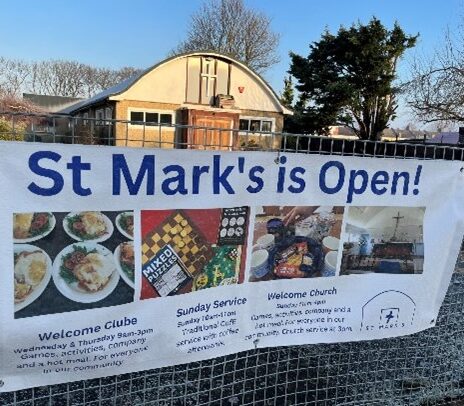
Messy Church meets monthly on a Wednesday after school and since the beginning of 2025 there has been no Sunday service at St Mark’s. Instead, Messy is thriving with some 40 people, adults and children, currently coming to sessions.
‘The key to that has been local ownership,’ says Nick. ‘When it was the church people ‘doing’ Messy Church to the community, it did not work. When the church people, the religious people, said, this is the way it’s going to be, you are going to conform to our culture and you are going to do things our way, that didn’t work.
‘But when we said, this is a community. In fact, it’s your community. It’s your project. Without you what’s the point? It’s for you get involved. You don’t like the food, give us some suggestions, or go in the kitchen. Or the activities aren’t messy enough? What do you want to do? The themes don’t mean anything to the kids. Well, let’s look at some themes.’
They’ve done some things that Nick’s brothers and sisters have frowned on slightly: ‘We did a Halloween session, and I told the story of the Battle of good and evil but called it Spooky Church. And it was huge! We had nearly 40 people in hearing the gospel. It was Halloween, and it wasn’t a Light Party, put it that way, but it was an opportunity to preach the gospel and to talk about the origins of Halloween being a church festival that we’ve lost.’
Increasingly, local families have got more and more involved and taken the lead while Nick goes on asking those crucial questions: can you see how this connects with the Christian faith? What really engages you guys? How can we bring more people in? In other words, keeping the faith aspect to it and keeping it as Messy Church, rather than just a community group. But local ownership has been crucial.
‘Once the non-church people started getting really stuck into Messy Church, that was when it took off, and that was when the gospel opportunities and the mission really happened.’
It’s hard, unpredictable but rewarding work. And there are many inspiring stories to leaven the challenges. ‘I went into the local primary school to do an assembly,’ says Nick, ‘and I said to one of the teachers I was from St Mark’s. She said, “Is that the one that does Messy Church?” “Yes, it is!” She said, “Ah, we have this kid who has a lot of issues with behaviour and struggles at school, but on a Messy Church Wednesday he will be talking all day about how excited he is about going to Messy Church and how much he’s looking forward to it. As he’s leaving the school gate he’s chanting Messy Church! Messy Church!” That’s a really powerful one.’
In October, Messy Church ministry lead, Aike Kennett-Brown, went to visit St Mark’s, Downham in South East London, along with a film crew from the Church Of England. You can watch the video here.

If you are thinking of starting a new Church of England Messy Church in an area of need, we offer support with micro grant funding. To find out more:

You may also like
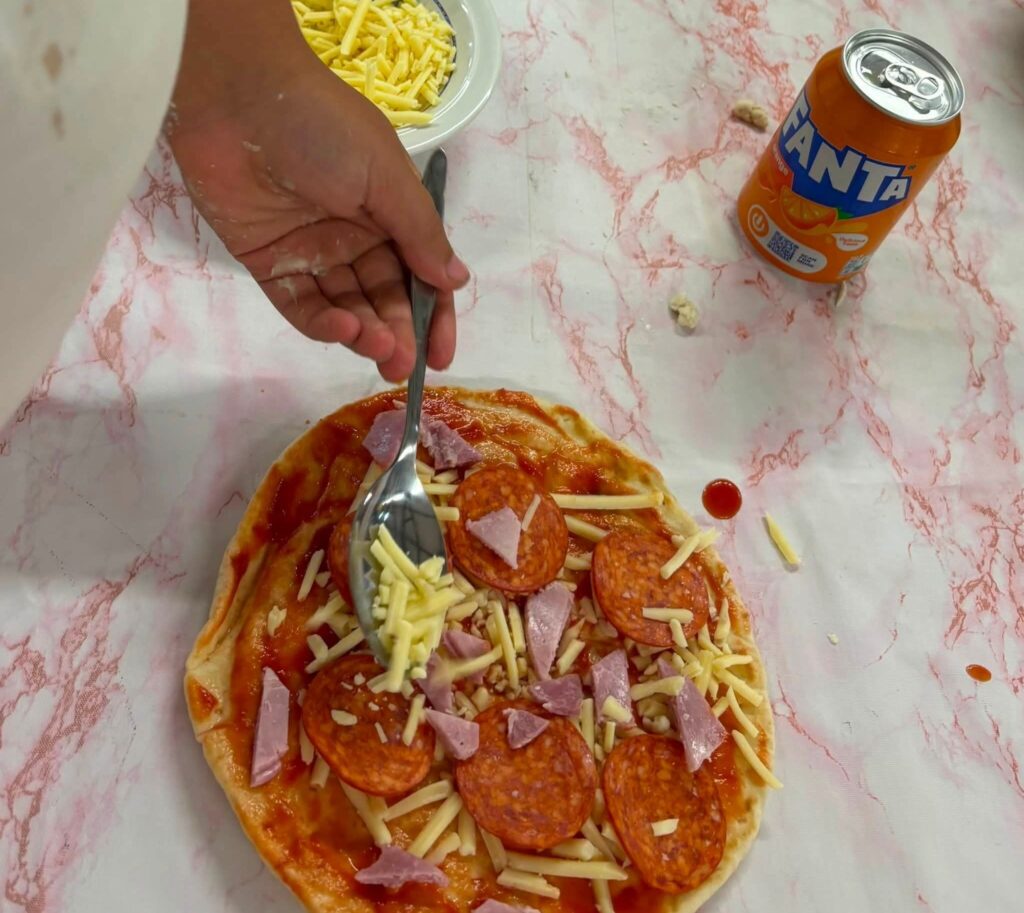
A small grant, a big difference! Discover how a Messy Church microgrant helped St Andrews Blidworth welcome local people, bring Bible stories to life, and build lasting community connections. Read how a simple invitation led to something special and how God might be at work in the most unexpected ways.
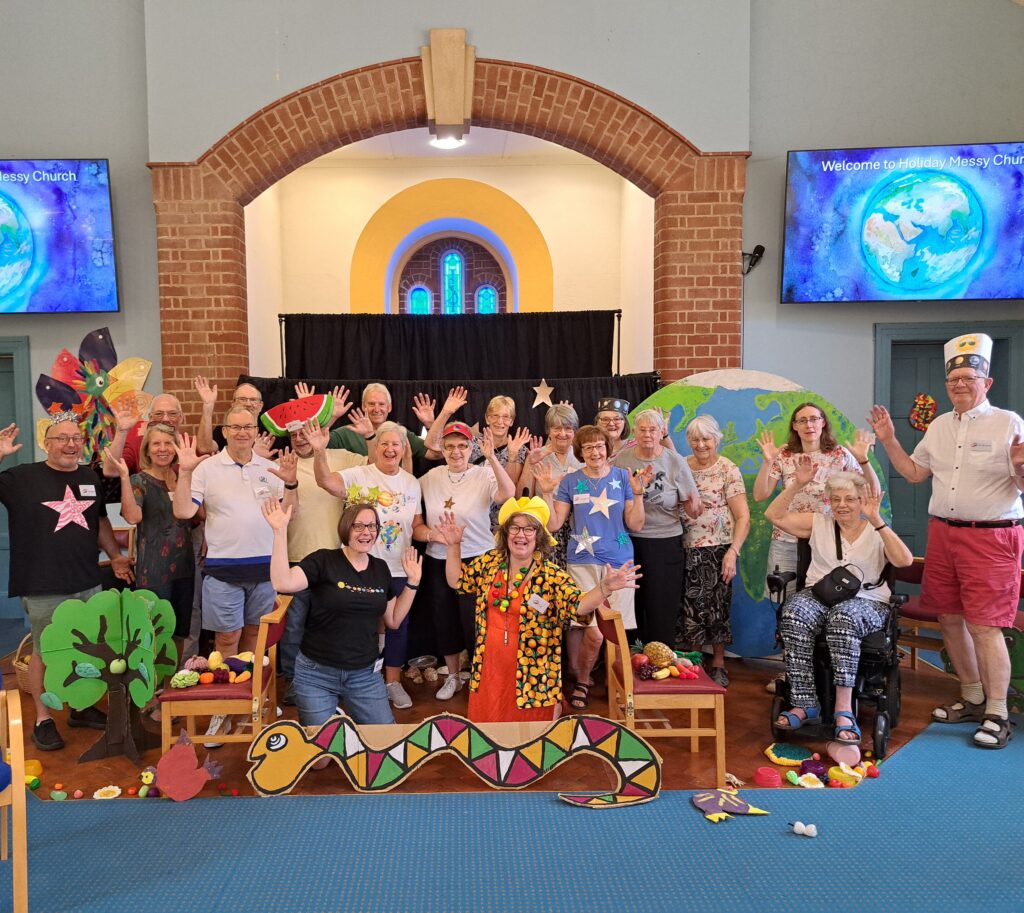
Messy Church… in the summer holidays! Droitwich Spa Methodist Church tried something new with a two-day holiday Messy Church, bringing children together for creativity, Bible stories, games and exploring God’s wonderful world. Find out how it went and why they’re already planning next year's!
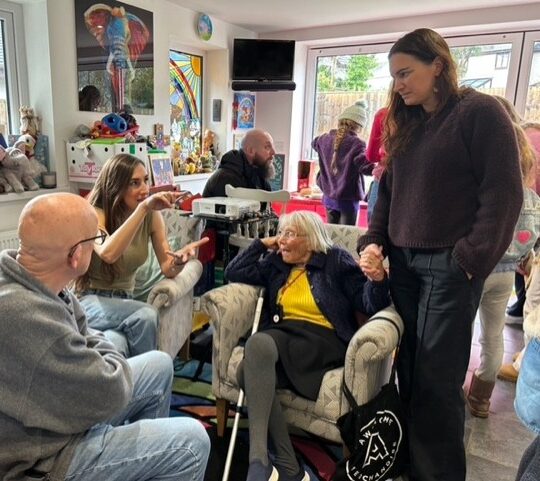
What happens when Messy Church becomes truly intergenerational? Meet Mary Judkins, whose extraordinary home-and-garden Messy Church brings together four generations and keeps teenagers coming back. Discover the relationships, challenges and joyful surprises behind this remarkable community.
Messy Church at St Eustachius in Tavistock had a communion service in July, which was a wonderful culmination of their Holy Habits series - written by Sarah Pendle, Messy Church leader
